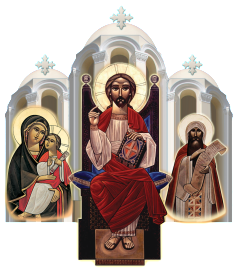

The Faces of Advent
Humility and Acquiescence – St Mary
When attempting to write about the humility and complete surrender of St Mary, words fall short of the greatness they are intended to convey. To say she is unique among all mankind does not do her justice. Entire hymns and prayers have been composed to praise her; yet we can continue to say more. As we pray in the lobsh of the Friday Theotokia, “What shall I call you, O All-Holy (Panagia) Virgin, who carried the Incomprehensible and Infinite One?”—even the Church itself confesses that language fails when it tries to describe her. She is truly the pride of our race. The Economy of Salvation would not have happened without her. She is prophesied about in the beginning of the Bible, the end, and all throughout it. This is the Mother of God; yet she humbly regarded herself as His maidservant. She is the one who bore the Lawgiver; yet she was faithful in obeying the Law. Her Son is the King of kings and Lord of lords; yet she submitted to Joseph, her betrothed. St Mary had plenty of reasons to boast. Yet she remained humble in spite of them all. She never lorded her status as the Theotokos over anybody. In fact, she only ever sought to help and serve others.
The first thing she did after the Archangel’s Annunciation was to go serve Elizabeth, her relative. She had plenty of reasons to avoid taking on this responsibility. Neither Elizabeth nor any of her other relatives informed her of her pregnancy. There was also the long and arduous journey to the hill country where Elizabeth lived; nevertheless, the Virgin went anyway. She refused to make excuses and fulfilled the Lord’s command to honor and serve her elders. Even Elizabeth marveled at this humility, saying, “Blessed are you among women, and blessed is the fruit of your womb! And why is this granted to me that the mother of my Lord should come to me?” (Luke 1:42-43).
In her response, “The Magnificat,” St Mary demonstrated her remarkable humility by giving all of the glory to God:
My soul magnifies the Lord, and my spirit rejoices in God my Savior, for he has looked on the humble estate of his servant. For behold, from now on all generations will call me blessed; for he who is mighty has done great things for me, and holy is his name. And his mercy is for those who fear him from generation to generation. He has shown strength with his arm; he has scattered the proud in the thoughts of their hearts; he has brought down the mighty from their thrones and exalted those of humble estate; he has filled the hungry with good things, and the rich he has sent away empty. He has helped his servant Israel, in remembrance of his mercy, as he spoke to our fathers, to Abraham and to his offspring forever (Luke 1:46-55).
Notice how she does not say anything like, “I am blessed,” or “God has rewarded me for my virtue and humility.” She does not demand that Elizabeth bow down and worship or reverence her. She doesn’t convey any notion of feeling like she deserves the praise of all future generations. She does not even thank Elizabeth for this praise. She simply relays the praise to God and humbly acknowledges that He is the one who is giving her this great blessing and glory. No common person would have behaved this way. How fitting it is that we likewise praise her, saying, “The Father looked from heaven, and found no one like you, He sent His Only-Begotten, who came and took flesh from you” (Wednesday Theotokia).
When it came to obeying the Law, no fault can be attributed to this beautiful saint. For she who needed no purification waited until “the time came for their purification according to the Law of Moses” (Luke 2:22) before bringing her son, the Savior, to the temple for His presentation. It is important to stress that she did not give birth to a common man. This is the Incarnate Word of God, not some common person who was conceived through human intercourse. St Mary likely did not need to wait the period of purification before presenting her son to the temple. Yet she waited anyway, without complaint. What remarkable submission and humility is this?
Furthermore, she completely submitted to Joseph in his role as the head of their household. This is evident in their fleeing to Egypt to escape Herod’s persecution. Despite St. Mary being the Mother of God, the Archangel appeared to Joseph, not the Theotokos, on multiple occasions. One would think that the Mother of God should have been the one the angel spoke to, given her exalted status. Yet, God has a specific order He wants us to live by. He ordained the man to be the head of the household, just as He is the head of the Church, and the woman to be the body, just as we constitute the body of the Church–His Bride. In her supreme humility, St Mary did not feel jealous, betrayed, or entitled to the angel’s visit. She did not think it wrong or inappropriate that the Archangel appeared to Joseph, despite her having become the mother of the One we, including the angels, all serve and worship. She also did not object to the long, difficult, and dangerous journey to that foreign country. Rather, she completely placed her trust in God and did not complain. She trusted that God would provide for their needs and obeyed her betrothed’s leadership. She simply humbled herself, declined to voice her opinion or concerns, and obeyed. In response, God greatly blessed and exalted her, for “God opposes the proud but gives grace to the humble” (James 4:6).
In conclusion, entire books could be written about the virtues of the Theotokos. She had intimate knowledge of Christ, yet did not write a Gospel, for it was not her role to do so. She was with the Disciples and Apostles during Pentecost, yet did not try to become a priest or hold a clerical position in order to be considered equal to them. In truth, she greatly exceeded them in humility, virtue, and blessedness; yet she did not teach or try to preach and evangelize, but rather, “Mary treasured up all these things, pondering them in her heart” (Luke 2:19), seeking God’s guidance in humility and silence, and following His leadership and direction at every turn. She understood the Spirit’s intention, which taught St Paul that, “And he gave the apostles, the prophets, the evangelists, the shepherds and teachers, to equip the saints for the work of ministry, for building up the body of Christ,” (Ephesians 4:11-12).
May the Lord also grant us the gifts of humility and submission, and allow us to learn from the beautiful example set by His mother. May her prayers and intercessions be with us all, and may they guide us to the eternal heavenly banquet. Amen.
Sources:
- Bible, ESV
- The Virtue of Submission, Homily by H.E. Metropolitan Youssef