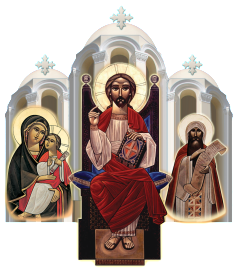
“The Comforter”
“When the Spirit of truth comes, he will guide you into all the truth” John16:13
On this Seventh Sunday of the Holy Fifty Days (Pashons 27), the Church reads from the Gospel according to St. John (John 15:26–16:15), in which our Lord Jesus Christ tells His disciples that He must depart, for through His departure the Comforter—the Holy Spirit—will come to them: “But when the Helper comes, whom I shall send to you from the Father, the Spirit of truth who proceeds from the Father, He will testify of Me” (John 15:26). This Gospel emphasizes the necessity of Christ’s Ascension so that the Comforter may descend upon the disciples, strengthening and guiding them in their apostolic mission.
The Lord Jesus lovingly prepared His disciples for what was to come, foretelling both the coming of the Holy Spirit and the tribulations they would endure from those who “have not known the Father nor Me” (John 16:3). Fr. Tadros Y. Malaty explains: “In perfect faithfulness, the Lord Jesus Christ reveals to the disciples the troubles they will face during the mission to which He will send them. However, these are the burdens of love; they are the arrows of love for His sake, for the world hates them as it hated Him.” The disciples would not be left alone in this mission. Rather, they would be empowered by the Comforter, the Holy Spirit, whom the Father would send in Christ’s name.
The Lord further declares: “Nevertheless I tell you the truth. It is to your advantage that I go away; for if I do not go away, the Helper will not come to you; but if I depart, I will send Him to you” (John 16:7). To the disciples, this must have seemed both unexpected and difficult to understand. How could Christ’s departure be beneficial?
Fr. Tadros Malaty explains that Christ’s Ascension is not a separation from His believers but rather the glorification of the Head, in which the members of His Body also participate. Through His death, Resurrection, and Ascension, Christ opened the way for humanity to receive the indwelling of the Holy Spirit. By His precious blood, He redeemed humanity, granted righteousness to believers, and restored to them access to heaven. Thus, the coming of the Holy Spirit is inseparably connected to the saving work of Christ. The Lord’s Incarnation, Crucifixion, Resurrection, and Ascension prepared the way for believers to receive and enjoy this divine gift.
What gifts, then, does the Holy Spirit grant us? St. John Chrysostom teaches that through the Holy Spirit believers are delivered from the “spirit of bondage” and receive “the Spirit of adoption,” becoming children of God and living in the freedom of Christ.
The Ascension of Christ brought to us the Comforter, the Holy Spirit, who bestows gifts upon the faithful. Yet beyond these gifts, what is the mission of the Holy Spirit within the Church?
The Holy Spirit continues and fulfills the saving work of Christ in the life of the Church. Fr. Tadros Malaty explains: “When the Holy Spirit comes, He grants humanity the life of repentance and a return to God through the Cross.”
The Holy Spirit works deeply within the human heart, convincing the mind and soul that true happiness, peace, joy, eternal life, and incorruption are found not in sin or worldly pleasures, but in steadfast communion with the Savior. He persuades humanity that the joy of life with God far surpasses the fleeting pleasures of the world. Thus, the mission of the Holy Spirit is to transform the human heart, drawing it away from worldly attachments and leading it into the love of God with all the heart, soul, mind, and strength.
The Incarnation, Crucifixion, Resurrection, and Ascension of our Lord Jesus Christ were all part of God’s divine plan to send us the Comforter, the Holy Spirit. Through Him, believers are equipped with heavenly gifts and guided toward repentance, holiness, and steadfastness in God. May the Holy Spirit continually work within us, convincing and persuading our hearts and minds to reject the vanity of the world and to seek the everlasting joy of life with God.
Resources:
Bible (ESV)
Catena Bible
Fr. Tadros Malaty Commentary on the Gospel of St. John
St. John Chrysostom Homily XIV on Romans 8:14–15