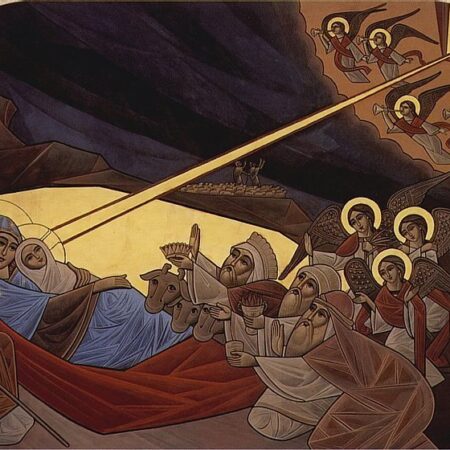
Today, we celebrate the blessed feast of the Nativity, the Birth of our Lord and Savior Jesus Christ. Today, Love took the form of a human being and dwelt among us. Fr. Matthew the Poor implores us to meditate on this Virginal Birth, saying, “What do we see in Bethlehem today besides a divine presence whose content is love, whose means is humility, and whose end is salvation?” (Love Took Flesh). There is so much we can learn from His incarnation, but we’ll focus today on these three: Love, humility, and salvation.
Love:
God is love, as St. John explains to us, “In this the love of God was made manifest among us, that God sent his only Son into the world, so that we might live through him” (1 John 4:7-9).
We know that our Lord is Love, and Love took flesh, but what is Love? Fr. Matthew the Poor explains, “To God, love is not an emotion but a self-offering” (Orthodox Prayer Life). Our Lord willingly offered Himself and served us, the undeserving sinners. As we pray in the annual Fraction to the Son, “We are the ones who were indebted to divine justice because of our sins, and He was the One who paid off the debts on our behalf. For our sake, He preferred suffering over joy, toil over rest, contempt over glory, and the Cross over the throne which is carried by the cherubim.”
The pure and sinless Christ paid our wages for us, “For the wages of sin is death, but the free gift of God is eternal life in Christ Jesus our Lord” (Romans 6:23). Thus, we see that the Lord truly loves us through His sacrifice and self-offering for us.
Humility:
“We find in Him strength in our extreme weakness, and uttermost weakness in our strength; for He bears both strength and humility” (Love Took Flesh).
Christ’s incarnation was not of extreme pride or wealth. Though Christ, the Logos and Son of the Father, could have been born in a palace or a place of power and honor, he chose to be born in a lowly manger for our sake. Having no place even in the inn, He was “wrapped in swaddling cloths and lying in a manger” (Luke 2:12). This humility is present throughout all of His life on earth, even at the Cross, where “He was oppressed, and he was afflicted, yet he opened not his mouth” (Isaiah 53:7).
In times that we are prideful or judgmental of others, let us remember that our Lord came to us in ultimate humility, teaching us to be humble and serve one another.
Salvation:
“Look up to Bethlehem and ponder for the born Babe is your own Son and Lord. He bears your nature, and it is He who sanctifies and redeems it” (Love Took Flesh).
Christ came for each and every one of us, for our salvation. As we chant in the Saturday theotokia, “The only-begotten of the Father • before all ages,• He emptied Himself, and took from you the form of a servant • for our salvation”.
Through the Eucharist, we are given the grace of communing with the living God. We become united in Him through this mystery and abide in Him and Him in us (cf. John 6:56).
As we look to the Babe born today, let us strive to love one another as Christ loved us, caring for the needs of others even more than our own needs. “Have this mind among yourselves, which is yours in Christ Jesus, who, though he was in the form of God, did not count equality with God a thing to be grasped, but emptied himself, by taking the form of a servant, being born in the likeness of men” (Philippians 2:5-7).
Let the Love who took flesh be inflamed in our hearts continually. To Him be the honor and glory forever and ever. Amen.
Sources:
- Bible, ESV
- The Coptic Psalmody
- The Divine Liturgies of Saints Basil, Gregory, and Cyril
- Love Took Flesh, Fr. Matthew the Poor
- Orthodox Prayer Life, Fr. Matthew the Poor