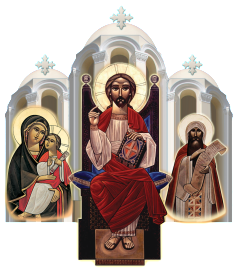

I Am the Bread of Life
Do not work for the food that perishes, but for the food that endures to eternal life,
which the Son of Man will give to you. John 6:27
On the first Sunday of Amshir, the Church reads from John 6:22-27. Despite its brevity, this Gospel passage reveals a profound spiritual journey, one that moves from seeking Christ, to uncovering our intentions behind believing in God, and finally to laboring for the food that endures unto everlasting life.
Following the miraculous feeding of the five thousand men (not counting women and children) and the disciples witnessing Jesus’ walking on water, crowds pursue Jesus. St John the Evangelist writes, “When the people therefore saw that Jesus was not there, nor His disciples, they also got into boats and came to Capernaum, seeking Jesus” (Jn 6:24). Notice that when the people didn’t find Jesus, they got into their boats and sought Him elsewhere, more specifically in Capernaum (village of consolation or comfort). Allegorically, this reflects a soul that is stirred to search for Christ yet has not fully understood where He is truly found. As St. Cyril of Alexandria explains that although the people moved with effort, their understanding remained earthly: “They sought Him with eagerness, yet their mind had not ascended beyond earthly things; for though they crossed the sea with their bodies, their heart remained bound to bread.”
The truth is we often look for Jesus in places where He wouldn’t be, yet, unlike the crowd in this passage, we persist in looking for Him in those ‘wrong’ places. God readily makes Himself available for us, and He is eagerly waiting for us.
This is evident in the Scripture: “Draw near to God and He will draw near to you” James 4:8, and “You will seek Me and find Me, when you search for Me with all your heart” Jeremiah 29:13. God reveals Himself on Mount Sinai and Mount Horeb, places of ascent, teaching us that the mind must rise above earthly distraction. He reveals Himself on Golgotha, teaching us that the flesh must be crucified. He is found in the gentle whisper (1 Kings 19:12), in the fragrant garden (Song of Songs 6:2) and in the glory filling Solomon’s temple (2 Chronicles 7:1-3). The point is that God is not absent, but we must be prepared to meet Him where He chooses to reveal Himself. However, are we prepared to meet Him? Are we ready to forgo our own desires to seek Him? Do we truly even want to meet Him in the first place?
Let’s return to the passage. Next, the people find Him on the other side of the sea and ask Him, “Rabbi, when did You come here?”. Jesus replies, “Most assuredly, I say to you, you seek Me, not because you saw the signs, but because you ate of the loaves and were filled.” John 6:25-26. Here, Jesus, in His wisdom unveils their intentions before them, as St. John Chrysostom explains that Christ’s rebuke is not harsh, but therapeutic: “He did not accuse them openly, but gently reproved them, showing that their desire was for the belly, not for the soul.”
This challenges us to examine our own faith. Do we seek God for who He is, or for what He gives? Do we pursue Him only when prayers are answered, needs are met, and comfort is supplied?
Pope Shenouda III echoes this concern with clarity: “Many approach God with prayers that are not prayers, but demands… God desires first the heart, not the benefit.” Let us ask God to make our intentions known and constantly purify them.
The last part of the passage Christ then redirects the people toward their true purpose: “Do not labor for the food which perishes, but for the food which endures to everlasting life, which the Son of Man will give you, because God the Father has set His seal on Him” John 6:27.The Apostolic Constitutions refers to this verse in explaining how we should go about conducting our lives: “Follow therefore your trades as by the by, for your maintenance, but make the worship of God your main business; as also our Lord said: Labor not for the meat which perishes, but for that which endures unto everlasting life.” Indeed, our main goal, primary purpose, and entire being is to worship God.
But how do we labor for everlasting life? It is simple. “We are to love God with all our heart and with all our soul and with all our mind” (Mt 22:37). But how is loving God a type of laboring? St John Chrysostom explains in his commentary on 1 Thessalonians 1:3: “Merely to love is no labor at all. But to love genuinely is great labor. For tell me, when a thousand things are stirred up that would draw us from love, and we hold out against them all, is it not labor?”
May we seek God with pure intentions and labor for the food that endures.
Sources:
- Bible, English Standard Version
- Catena Bible, Commentary on John
- Catena Bible, Commentary on 1 Thessalonians
- St. Cyril of Alexandria, Commentary on the Gospel of John, Book IV, PG 73:580–581.
- St. John Chrysostom, Homilies on the Gospel of John, Homily 45, PG 59:260.
- Pope Shenouda III, The Life of Faith, Ch. “Purity of Intention.”
- Apostolic Constitutions, Book II, Ch. 36, PG 1:725.
- St. John Chrysostom, Homilies on 1 Thessalonians, Homily 2, PG 62:425.